Indian Police Service · Maharashtra
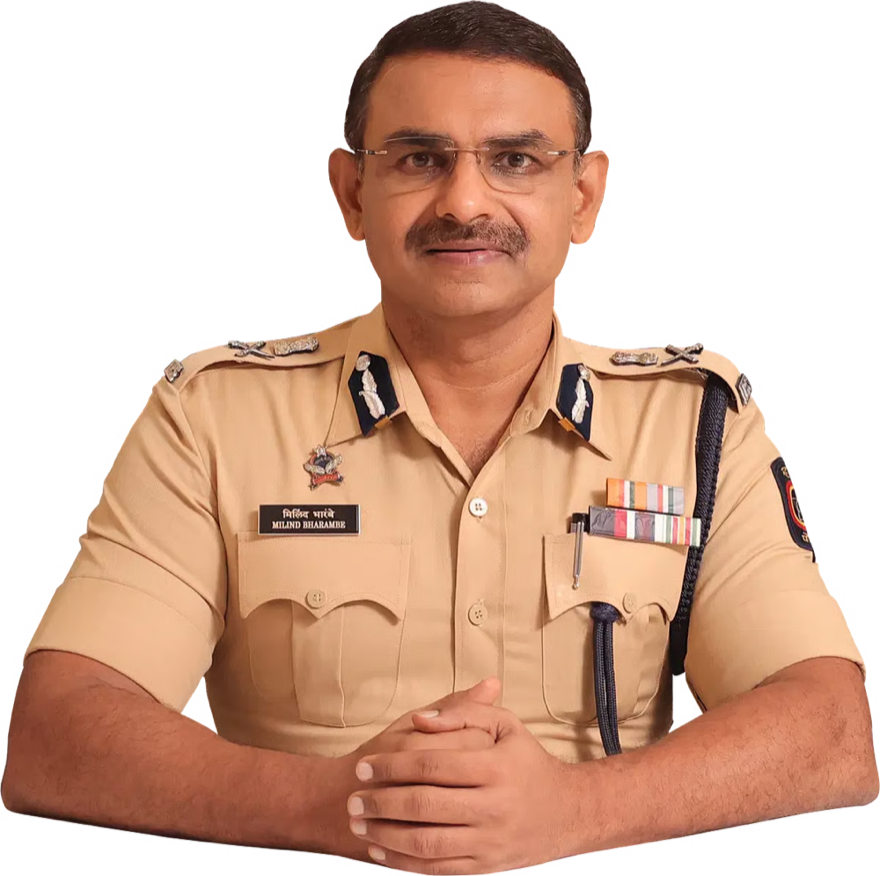
Milind Bharambe
IPS
Commissioner of Police, Navi Mumbai Additional Director General of Police
Introduction
A career built across the different dimensions of policing.
Milind Bharambe joined the Indian Police Service in 1997 and has served the Maharashtra cadre since. His record is notable less for a single specialism than for its breadth: the work of a police officer changes substantially depending on whether the ground under him is a district, a traffic network, a range headquarters or a metropolitan commissionerate, and he has held responsibility in each of those environments.
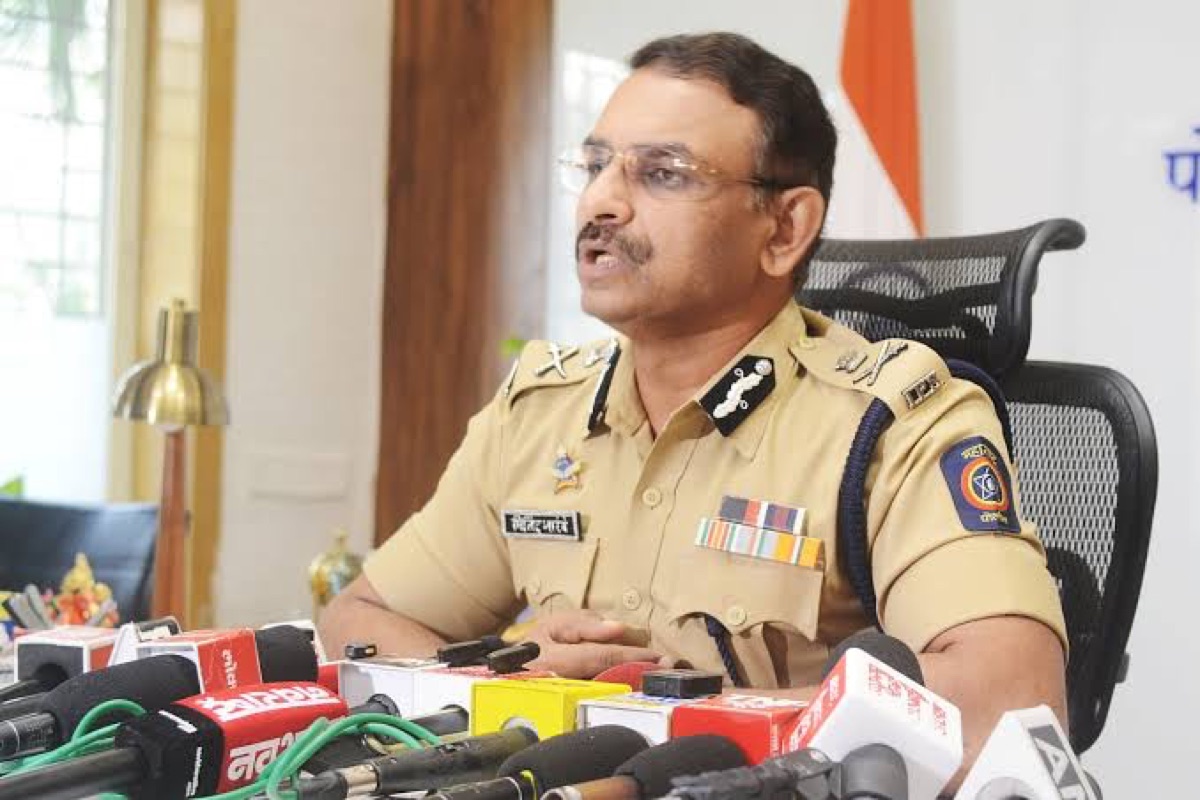
Between April 2015 and April 2017 he headed the Mumbai Traffic Police as Joint Commissioner of Police (Traffic) — a posting that treats a city not as a map of jurisdictions but as a system in motion. He subsequently served as Special Inspector General of Police for the Aurangabad Range, and later at state level in Mumbai on law and order. He returned to the metropolis as Joint Commissioner of Police (Crime), Mumbai, the appointment he held immediately before his present one.
On 14 December 2022 he assumed charge as Commissioner of Police, Navi Mumbai. The commissionerate he now leads covers one of India’s few comprehensively planned cities — a place whose grid of nodes, corridors and industrial estates makes it an unusually legible test of what contemporary urban policing has to do.
The pages that follow set out that career, the institutional questions it raises, and the documented work of the commissionerate he commands. Where a claim rests on a published source, the source is named.
Policing a city is not one problem.
- 01Public order
- 02Crime prevention
- 03Traffic & mobility
- 04Citizen grievances
- 05Emergency response
- 06Technology
- 07Cybercrime
- 08Women’s safety
- 09Public events
- 10Community confidence
- All of it, at once — the commissionerate
A commissionerate does not work through a queue. Every one of these responsibilities is live at the same hour, competes for the same personnel, and is judged by a different public. A festival procession, a bank fraud reported from a flat in Kharghar, a chain-snatching in a market lane and a signal failure on a trunk road are not variations of one task — they demand different skills, different units and different tempos.
What the diagram describes is the actual shape of the job: not a hierarchy of priorities but a network of them, in which capacity moved toward one node is capacity taken from another. Command, at this level, is largely the discipline of allocating attention.
- 01Order maintained in public space, continuously and without incident
- 02Crime prevented before it is investigated
- 03A city kept moving — and moving safely
- 04Complaints heard, recorded and answered
- 05Response measured in minutes, not hours
The Ground
Navi Mumbai
Navi Mumbai was conceived as a planned counter-magnet to Mumbai and built outward from a deliberate structure: discrete nodes — Vashi, Nerul, Belapur, Kharghar, Airoli, Panvel and their neighbours — each subdivided into numbered sectors, each linked by designed corridors rather than by accretion.
That structure has consequences for policing. Residential sectors, commercial districts, industrial estates and transport interchanges are not blurred together; they sit in identifiable blocks with identifiable rhythms. A node that is quiet at eleven in the morning may hold a very large evening crowd. An arterial road that carries commuters at dawn carries freight at night.
The city has also kept growing. Commercial development, residential expansion and new transport infrastructure continue to change how many people are present in a given node, at what hours, and by what route they arrive. A police deployment designed for the city of a decade ago would not fit the city of today.
- Planned structure
- Development organised into nodes and numbered sectors rather than an unbroken urban sprawl.
- Mobility
- Rail, arterial highway and expressway corridors carry commuter, freight and inter-city movement across the same ground.
- Mixed land use
- Residential sectors, commercial hubs, institutional campuses and industrial estates each generate distinct demands.
- Public assembly
- Markets, transport interchanges, festivals and large organised events concentrate crowds predictably — and occasionally without warning.
Professional Snapshot
Six lines of responsibility, and where each one is set out.
The Human Dimension
The institution is experienced through people.
Very few citizens ever encounter a police force as an organisation chart. They encounter it as a constable at a junction, a duty officer at a station counter, a voice answering an emergency line, an investigating officer who returns a call — or who does not.
That is why professional conduct is not a soft consideration sitting alongside operational performance. It is operational performance. A complainant treated with dignity is a complainant who reports the next offence. A neighbourhood that finds the station approachable is a neighbourhood that passes on what it knows.
The measures that follow from this are unglamorous and specific: making the station reachable, answering what is asked, keeping a complainant informed after the first visit, and holding the force to a standard of behaviour in public that the public can recognise.
- AccessibilityA station, a line and a channel that can actually be reached.
- ResponsivenessAn answer that arrives while it still matters.
- ProfessionalismConduct that does not depend on who is watching.
- DignityThe complainant treated as a citizen, not a case number.