Profile — 02 of 08
The officer
behind the role.
A designation describes a chair. It says very little about the working life that leads to it — the range of ground covered, the kinds of problem handled, and the professional habits formed along the way.
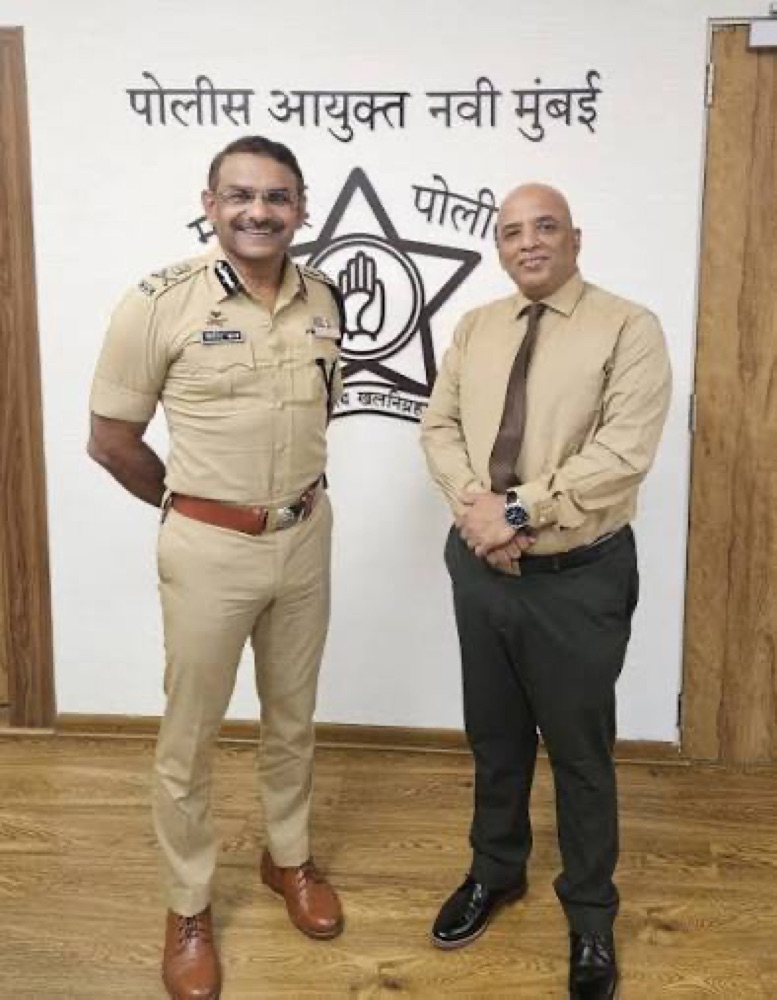
Senior police leadership in India is not conferred by seniority alone; it is assembled out of postings. An officer who has held a district charge has answered for everything that happens on a defined piece of ground. An officer who has run a traffic organisation has managed a system rather than a territory. An officer who has served at range or state level has worked at the distance where policy, not instruction, is the instrument. The value of a varied record is that each of those environments teaches something the others cannot.
Milind Bharambe’s service reflects that pattern. Appointed to the Indian Police Service in 1997 and allotted the Maharashtra cadre, he has held operational charge in the field, headed the traffic organisation of India’s densest metropolis, served as Special Inspector General of Police for a range, held state headquarters responsibility for law and order, led the crime portfolio of the Mumbai Police, and now commands a metropolitan commissionerate.
The account on this page is deliberately restricted to what appears in official records and in established reporting. Where the public record is silent — on educational background, for example, or on the sequence of his earliest district assignments — this site does not fill the gap with invention.
Professional Identity
The record, as it is documented.
Shri Milind Bharambe, IPS
Government orders record the officer’s full name as Milind Rambhau Bharambe. The shorter form, Milind Bharambe, is the one used in official listings and in public communication, and it is the form used throughout this site.
Indian Police Service — Maharashtra cadre, 1997
The IPS is one of the three All India Services. Officers are recruited nationally and allotted to a state cadre in which they spend the substance of their careers, moving between district charge, specialised branches, range and state headquarters, and central deputation. Milind Bharambe has served the Maharashtra cadre since 1997.
Additional Director General of Police
ADGP is among the senior-most ranks in a state police organisation, sitting immediately below Director General of Police. His appointment to Navi Mumbai followed promotion to this rank.
Not established in the public record
No official government publication consulted for this site sets out Milind Bharambe’s educational qualifications. Rather than reproduce an unsourced claim, this site records the absence. Should an authoritative source publish those details, the section will be completed from it.
Held across the career to date
Each of the following corresponds to a documented appointment rather than to a general description of police work.
- Field & district policing
- Traffic management
- Law & order
- Crime investigation
- Range command
- State headquarters
- Metropolitan command
Commissioner of Police, Navi Mumbai
Charge assumed 14 December 2022, on transfer from Joint Commissioner of Police (Crime), Mumbai. The Government of Maharashtra continues to list him in this appointment.
Career Context
Command is assembled from unlike environments.
The postings below are the ones confirmed by official listings and established reporting. They are set out here for what each one demands, because the demands differ sharply.
Field and district policing places an officer at the point where policing is actually experienced — local ground, local knowledge, direct public contact, and decisions taken without the luxury of consultation.
Mumbai Traffic Police is not a territorial charge at all. It is the management of a continuous system whose performance is visible to the whole city every day, and whose failures are measured in hours of collective time and in lives.
Range command — as Special Inspector General of Police, Aurangabad Range — supervises districts rather than running one, which is a different discipline: setting standards, arbitrating between units, and intervening rarely but decisively.
State headquarters responsibility for law and order operates at a further remove again, where the instrument is policy, coordination and the allocation of state resources.
Joint Commissioner of Police (Crime), Mumbai returned him to the metropolis with charge of its investigative machinery — the branch work of a city police force rather than its territorial divisions.
Commissioner of Police, Navi Mumbai combines all of it. A commissioner holds unified charge of a metropolitan force: law and order, crime, traffic, specialised units, personnel and public accountability, in one command.

The Appointment
What a Commissioner of Police is responsible for.
In the commissionerate system, a metropolitan area is removed from the district-and-magistrate arrangement that governs the rest of the state and placed under a single police authority. The Commissioner of Police holds unified command of the force in that area and also exercises certain regulatory powers that would otherwise sit with the district administration — among them the powers governing public assembly, processions and preventive orders.
Practically, the appointment carries four standing obligations at once. The first is public order: keeping the peace across a city that assembles, celebrates, protests and commutes. The second is crime: preventing what can be prevented and investigating what cannot, to a standard that survives a courtroom. The third is service: the counter, the helpline, the certificate, the complaint — the routine transactions through which most citizens actually meet the police. The fourth is the force itself: thousands of personnel who must be posted, trained, equipped, disciplined and kept capable of the first three.
None of these can be deferred while another is attended to, which is the recurring theme of this site and the reason the following pages are organised around systems rather than around anecdotes.