JavaScript required

This website uses a passcode gate and cannot be displayed without JavaScript. Please enable JavaScript in your browser and reload the page.

Leadership — 05 of 08

Leadership under complexity.

An analytical account of what police command actually requires in a metropolitan commissionerate — written as an examination of the institution, not as a tribute to an individual.

Subject
Police command in a metropolitan commissionerate
Frame
Institutional analysis
Structure
Five operating principles
Attribution
The principles below are this site’s analysis. They are not presented as statements by Milind Bharambe, and none is placed in quotation marks.

Command of a police force differs from most other forms of executive leadership in one specific way: almost nothing that matters can be scheduled. A commissioner sets priorities in the knowledge that any hour may reassign them, and that the force will nonetheless be judged on the priorities as well as on the interruption.

Five requirements follow from that condition. They are not a philosophy so much as a description of what the job structurally demands of whoever holds it.

Five operating principles

Clarity

An order that has to be interpreted has already failed.

A police organisation executes through people who are frequently alone, often at night, and rarely able to seek clarification. Whatever ambiguity exists in an instruction at the top is resolved — unpredictably — by the officer at the bottom.

Clarity therefore means more than plain language. It means that priorities are ranked rather than merely listed, that the boundary of discretion is stated, and that the standard by which the work will be judged is known in advance rather than discovered afterwards. A force told what matters most can decide sensibly when two demands collide; a force told that everything matters will decide by chance.

Discipline

The standard is what happens when no one is checking.

Discipline in a police service is often reduced to punishment. That is its smallest part. Its substance is procedural: the entry made at the time rather than later, the seizure documented properly, the complainant recorded whether or not the complaint is convenient, the register kept accurately on a quiet night.

These are unglamorous, and they are the difference between a case that survives trial and one that does not. Because supervision cannot be everywhere, the only workable form of discipline is one the force applies to itself — which makes it a question of culture, and therefore of what leadership visibly rewards and visibly refuses to overlook.

Coordination

Most police failures are seams, not gaps.

A commissionerate is a set of specialised units — territorial divisions, crime branch, traffic, cyber, women’s units, control room, forensic and legal support — each competent within its own remit. Serious failures rarely occur because a unit could not do its job. They occur at the joins: information held in one unit that was needed in another, a handover made late, an assumption that someone else had acted.

Coordination extends well beyond the force. Emergency services, civic authorities, transport operators, prosecutors, forensic laboratories and neighbouring jurisdictions all sit on the critical path of ordinary police work. None of them reports to the commissioner. Command therefore consists substantially of arranging cooperation that cannot be ordered.

Adaptability

The threat changes faster than the establishment does.

Police organisations are built for continuity, which is a strength when the problem is stable and a liability when it is not. Cybercrime is the clearest current example: within a few years it moved from a specialist curiosity to an ordinary category of complaint, arriving faster than sanctioned strength, training pipelines or procedure could be revised.

Adaptability is the capacity to reallocate ahead of formal change — to stand up a capability, redirect trained officers, and revise practice before the establishment catches up. It carries risk, because reallocation always costs something elsewhere, and it is one of the judgements a commissioner cannot delegate.

Accountability

Authority that cannot be questioned decays.

The police hold powers no other civil institution holds. The legitimacy of those powers rests on their being answerable — to law, to the courts, to government, and to the public whose consent makes routine policing possible at all.

Internally, accountability means that outcomes are attributable: that a decision has an author, that a case has an officer, and that neither disappears into the organisation. Externally, it means the force explains itself in public, including when the account is uncomfortable. An institution that only speaks when the news is good is not trusted when the news is bad.

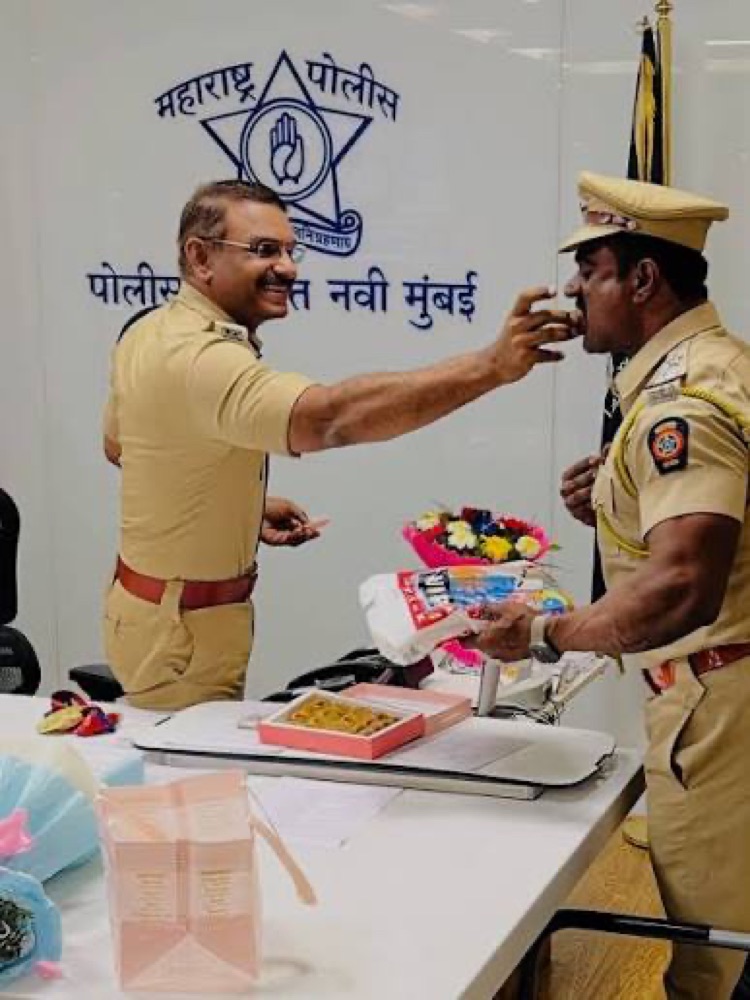
Milind Bharambe offering sweets to a police officer in a moment of felicitation at the Navi Mumbai Police Commissioner's office.
Recognition inside the force: morale is an operational input, not a courtesy.

Capability

The force is the capability.

Every plan a commissionerate makes is executed by police personnel. Equipment and technology change what they can do; they do not change who does it. The practical consequence is that the condition of the force is the single largest determinant of what the organisation can actually deliver.

Training decides whether a capability exists in fact or only on paper — a cyber unit without trained investigators is an organisational chart. Discipline decides whether procedure holds under pressure. Communication decides whether the intention at the top survives the distance to the ground.

Morale is the input most easily dismissed and most quickly felt. Police work involves long hours, disrupted rest, exposure to distress and public criticism. A force that believes its conditions and its efforts are taken seriously will absorb an operational surge; one that does not will show the strain in absence, error and attrition.

Operational readiness is the aggregate of all of it: whether the right people, adequately trained and in acceptable condition, can be at the right place in time.

This site describes these as institutional requirements. It does not attribute specific internal programmes to any individual except where an initiative is documented in a published source — those appear on the initiatives page.

Public Confidence

Trust is an operational asset.

Public confidence is usually discussed as a matter of reputation. Treated analytically it is something harder: an input the police depend on to function, and one whose absence degrades performance in measurable ways.

The mechanism is straightforward. Police forces learn about crime overwhelmingly from the public. Where confidence is low, offences go unreported — not because they did not occur but because reporting is judged futile or costly. The recorded picture becomes inaccurate, and every decision built on it, from deployment to prevention, is built on a false map.

The same applies downstream. Witnesses who trust the process appear; witnesses who do not, retract. Communities that trust the station pass on early warning of tension; communities that do not, wait until the tension is visible. Emergency calls arrive sooner where people believe someone will come. Each of these is an operational variable, and each responds to how ordinary encounters are handled.

01 — Reporting

Confidence determines how much crime the force ever learns about, and therefore how accurate its picture of the city is.

02 — Cooperation

Witnesses, complainants and neighbourhoods either sustain a case through to court or quietly withdraw from it.

03 — Response

Calls made early, and made at all, are what allow response time to mean anything.

04 — Communication

Advisories and warnings only work if the public credits the source issuing them.

05 — Prevention

Most prevention depends on information arriving before an offence, which depends on someone deciding it is worth passing on.

06 — Grievance

A complaint answered maintains the relationship; one ignored ends it, along with everything above.

None of this argues that confidence should be pursued for its own sake, or that policing should be shaped by approval. It argues the opposite: that the instrumental case for professional, courteous and responsive conduct is at least as strong as the ethical one, and that a force which treats public confidence as optional is choosing to work with worse information.

Milind Bharambe in uniform speaking at a briefing table with a microphone and a presentation screen behind him.
Explaining the work in public is part of doing the work.

What the commissionerate has done